
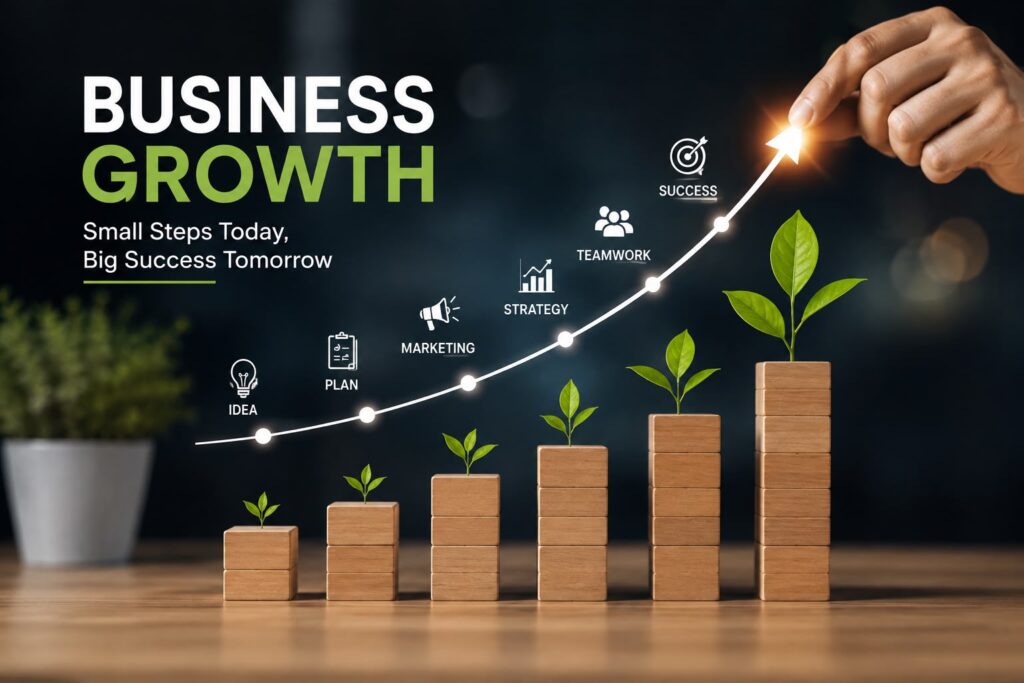
1. Start With Clarity: What Does “Growth” Mean for You?
Before tactics, define success. Growth can mean different things at different stages:
- More revenue or profit
- More customers or repeat purchases
- Better margins or cash flow
- Expansion into new markets, locations, or products
Pick one primary growth target for the next 90 days (e.g., “+20% qualified leads” or “+15% monthly revenue”) and let everything else support that.
2. Diagnose What’s Actually Holding You Back
Most businesses are limited by one of these constraints:
- Demand: Not enough people know about you (traffic, leads).
- Conversion: People know you but don’t buy (offers, messaging, sales process).
- Retention: People buy once but don’t come back (onboarding, experience, follow‑up).
- Capacity: You can’t deliver more without breaking things (team, systems, operations).
- Unit economics: Pricing and costs don’t support profitable growth.
3. Build the Foundation: Your Website as a Growth Engine
Your website is your home base; everything else drives traffic and trust back to it.
Key points to cover:
- Clear positioning: Who you help, what problem you solve, and why you’re different—above the fold.
- Fast, mobile-friendly design: Most traffic is mobile; slow sites lose leads and hurt SEO.
- Strong calls to action (CTAs): “Book a call,” “Get a quote,” “Start free trial,” etc., repeated throughout key pages.
- Trust signals: Reviews, case studies, logos, testimonials, guarantees, clear contact info.
- Basic analytics: Install Google Analytics and set up conversion tracking so you know what’s working.
4. Get Found: SEO and Local Visibility
Search is one of the most reliable long‑term growth channels because it captures people already looking for solutions.
Core SEO ideas
- Keyword research: Identify phrases your ideal customers use (e.g., “best [service] in [city]”).
- On‑page optimization: Use those keywords in titles, headings, meta descriptions, and naturally in content.
- Helpful content: Publish pages and blog posts that answer real questions, not just “about us” fluff.
- Internal linking: Connect related pages so visitors (and Google) can easily navigate your site.
Local SEO (if you serve a specific area)
- Set up and optimize your Google Business Profile with photos, services, hours, and regular posts.
- Collect and respond to customer reviews; they significantly boost local rankings and trust.
- Ensure your name, address, phone (NAP) are consistent across your site and directories.
5. Create Content That Builds Authority and Leads
Content marketing turns your expertise into a repeatable lead generator.
Teach readers to think in terms of:
- Top of funnel: Educational posts that attract strangers (how‑tos, checklists, common mistakes).
- Middle of funnel: Comparison and decision content (vs. posts, “best X for Y,” case studies).
- Bottom of funnel: Proof and offer content (testimonials, detailed case studies, pricing, guarantees).
For each piece of content:
- Include a clear CTA (download, book, subscribe, contact).
- Repurpose one idea into multiple formats: blog → social posts → email → short video.
6. Use Social Media Strategically, Not Randomly
Social media is less about “going viral” and more about consistent visibility and trust‑building.
Key principles:
- Choose 1–2 platforms where your ideal customers actually spend time.
- Post consistently with a simple cadence you can sustain (e.g., 2–3 times/week).
- Mix content types: educational tips, behind‑the‑scenes, customer stories, offers.
- Engage, don’t just broadcast: reply to comments, join relevant groups, comment on others’ posts.
Emphasize that social supports SEO, email, and referrals; it’s part of a system, not a silver bullet.
7. Build and Use an Email List From Day One
Email is one of the highest‑ROI channels because you own the audience.
Core steps:
- Offer a lead magnet (checklist, guide, discount, quiz) in exchange for email.
- Use a simple welcome sequence (3–5 emails) that introduces your brand, shares value, and makes an offer.
- Send regular newsletters (weekly/biweekly) with useful content, updates, and occasional promotions.
- Segment over time (new leads, customers, inactive subscribers) to send more relevant messages.
8. Accelerate With Paid Advertising (When Ready)
Paid ads are for speeding up what already works, not fixing a broken offer.
Good candidates:
- Search ads (Google): Capture high‑intent searches (“[service] near me”).
- Social ads (Meta, LinkedIn, TikTok): Target by interests, behaviors, job titles, or location.
- Retargeting ads: Show ads to people who visited your site but didn’t convert.
Key guidelines:
- Start with a clear goal (leads, bookings, sales).
- Use tight geo‑targeting if you’re local (3–10 km radius).
- Test small budgets, measure results, and scale what’s profitable.
9. Improve Conversion: Turn More Visitors Into Customers
Growth isn’t just more traffic; it’s better conversion at each step.
Focus areas:
- Offer clarity: Is it obvious what you’re selling, to whom, and why it matters?
- Landing pages: Dedicated pages for key offers with minimal distractions and strong CTAs.
- Social proof: Reviews, ratings, case studies, before/after results.
- Friction reduction: Simple forms, clear pricing, multiple contact options, fast load times.
- Follow‑up: Automated emails/SMS after form submissions, calls, or abandoned carts.
Even small improvements (e.g., 1–2% higher conversion) compound quickly.
10. Keep Customers Coming Back: Retention and Expansion
It’s often cheaper and more profitable to grow by keeping and expanding existing customers than by chasing only new ones.
Ideas to include:
- Onboarding: Clear next steps, welcome emails, quick win for new customers.
- Check‑ins: Regular satisfaction checks, usage tips, and “how’s it going?” messages.
- Loyalty programs / repeat offers: Discounts, bundles, subscriptions, membership options.
- Upsells and cross‑sells: Logical next products/services that increase value for the customer.
- Referral programs: Incentivize happy customers to refer others.
11. Measure, Learn, and Optimize
Growth is a loop, not a one‑time plan.
Encourage readers to:
- Define 3–5 key metrics (e.g., website visitors, leads, conversion rate, customer acquisition cost, repeat purchase rate).
- Review performance monthly, adjust tactics weekly.
- Kill what doesn’t work, double down on what does.
- Document what they learn so they can repeat successes.
A simple rhythm: Plan → Execute → Measure → Improve → Repeat.
12. A Simple 90‑Day Growth Plan (Practical Framework)
End your post with a concrete action plan readers can copy:
Month 1 – Foundation
- Clarify your 90‑day growth target and main constraint.
- Audit and improve your website (speed, mobile, CTAs, trust).
- Set up analytics and basic tracking.
- Launch or optimize your Google Business Profile (if local).
Month 2 – Traffic + Leads
- Publish 2–4 high‑value content pieces (blog posts, guides).
- Start a simple lead magnet and email capture.
- Begin consistent posting on 1–2 social platforms.
- Ask recent customers for reviews.
Month 3 – Conversion + Scaling
- Improve your highest‑traffic pages (better headlines, CTAs, proof).
- Start a basic email nurture sequence.
- Test a small paid campaign on your best channel.
- Implement one retention/upsell idea (follow‑up email, bundle, loyalty offer).
Encourage readers to adapt this to their industry, budget, and stage.